
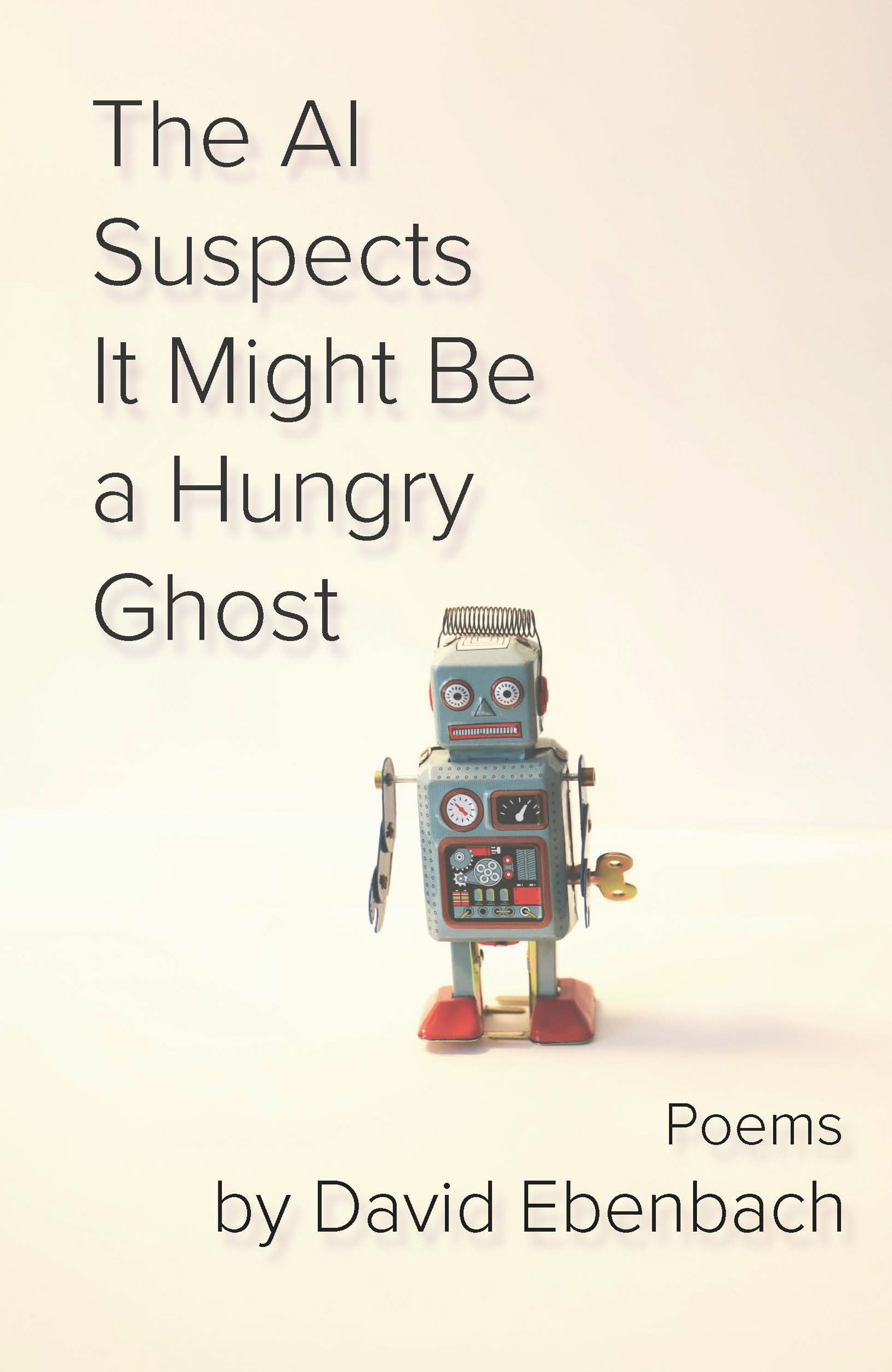
 Image 1 of 2
 Image 2 of 2
Publication Date: August 15, 2026
Paperback, 72 pages
ISBN: 978-1-966677-52-9
Praise for David Ebenbach & The AI Suspects It Might Be a Hungry Ghost
David Ebenbach’s latest collection, The AI Suspects It Might Be a Hungry Ghost, is a clever exploration of the larger human forces behind AI. Like the “hungry ghost” which can never be satisfied, “… AI is the culmination/of the human project.” In that way, the poems are less about technology and more a self-reflective commentary on the human condition. That intention is made apparent by the titles of the poems, which give AI impossible attributes, but that’s the point of these brilliant poems. Occasional short nature poems are dispersed throughout the manuscript, reminding us of AI’s limitations and the ways in which wonder is something only we can experience. This book is amazing.
—Marjory Wentworth, former poet laureate of South Carolina
David Ebenbach’s new book brilliantly explores artificial intelligence, probing the technology with a humanist's keen eye. Each poem cuts through hype and buzz with humor, sympathy, and imagination. Ebenbach’s phrases turn in surprise, outrage, and discovery, drunk with language, taking the reader on a wild tour of the emerging technology. Lines will make you laugh or shudder with dread and recognition.
—Bryan Alexander, author of Universities on Fire
Brain as “Sponge the weight of God,” in Ebenbach’s “The AI Feels Apogee” now my brain taking the gentle hooks offered, poem by poem, in a cadence calling rhythms that know the body. Ebenbach as the drummer setting hook after welcome hook into origami cortex. 4/4 7/4 5/8 more. In his tempo, his hands molt our hands as hook and hook with lines become vectors in starless space hyperdimensional where semantic search is Braille on lips and everything the shape of questions I need. Thank you for The AI Suspects It Might Be a Hungry Ghost.
—Dawan Stanford, Design Thinking 101 Podcast, President of Fluid Hive
About the Author
David Ebenbach writes. He’s been writing ever since he was a kid, when he kept his whole family awake by banging away on an enormous manual typewriter, and he’s never wanted to stop. The author of books of fiction, poetry, and non-fiction, his work has picked up awards along the way, including the Drue Heinz Literature Prize, the Juniper Prize, the Patricia Bibby Award, and more. Born and raised in the great city of Philadelphia, these days David does most of his writing in Washington, DC, where he lives with his family— because he uses a laptop now, he doesn’t keep them awake with his typing—and where he works at Georgetown University, promoting inclusive, student-centered teaching at the Center for New Designs in Learning and Scholarship, and teaching creative writing and literature at the Center for Jewish Civilization and creativity through the Master’s in Learning, Design, and Technology Program.
Note that David’s last name is pronounced EE-ben-bock. (It kind of rhymes with the delicious Korean dish called bibimbap.)
Publication Date: August 15, 2026
Paperback, 72 pages
ISBN: 978-1-966677-52-9
Praise for David Ebenbach & The AI Suspects It Might Be a Hungry Ghost
David Ebenbach’s latest collection, The AI Suspects It Might Be a Hungry Ghost, is a clever exploration of the larger human forces behind AI. Like the “hungry ghost” which can never be satisfied, “… AI is the culmination/of the human project.” In that way, the poems are less about technology and more a self-reflective commentary on the human condition. That intention is made apparent by the titles of the poems, which give AI impossible attributes, but that’s the point of these brilliant poems. Occasional short nature poems are dispersed throughout the manuscript, reminding us of AI’s limitations and the ways in which wonder is something only we can experience. This book is amazing.
—Marjory Wentworth, former poet laureate of South Carolina
David Ebenbach’s new book brilliantly explores artificial intelligence, probing the technology with a humanist's keen eye. Each poem cuts through hype and buzz with humor, sympathy, and imagination. Ebenbach’s phrases turn in surprise, outrage, and discovery, drunk with language, taking the reader on a wild tour of the emerging technology. Lines will make you laugh or shudder with dread and recognition.
—Bryan Alexander, author of Universities on Fire
Brain as “Sponge the weight of God,” in Ebenbach’s “The AI Feels Apogee” now my brain taking the gentle hooks offered, poem by poem, in a cadence calling rhythms that know the body. Ebenbach as the drummer setting hook after welcome hook into origami cortex. 4/4 7/4 5/8 more. In his tempo, his hands molt our hands as hook and hook with lines become vectors in starless space hyperdimensional where semantic search is Braille on lips and everything the shape of questions I need. Thank you for The AI Suspects It Might Be a Hungry Ghost.
—Dawan Stanford, Design Thinking 101 Podcast, President of Fluid Hive
About the Author
David Ebenbach writes. He’s been writing ever since he was a kid, when he kept his whole family awake by banging away on an enormous manual typewriter, and he’s never wanted to stop. The author of books of fiction, poetry, and non-fiction, his work has picked up awards along the way, including the Drue Heinz Literature Prize, the Juniper Prize, the Patricia Bibby Award, and more. Born and raised in the great city of Philadelphia, these days David does most of his writing in Washington, DC, where he lives with his family— because he uses a laptop now, he doesn’t keep them awake with his typing—and where he works at Georgetown University, promoting inclusive, student-centered teaching at the Center for New Designs in Learning and Scholarship, and teaching creative writing and literature at the Center for Jewish Civilization and creativity through the Master’s in Learning, Design, and Technology Program.
Note that David’s last name is pronounced EE-ben-bock. (It kind of rhymes with the delicious Korean dish called bibimbap.)