
 Image 1 of 2
 Image 2 of 2
HOVER HERE, poetry by Marjorie Maddox
Publication Date: January 31, 2026
Paperback, 112 pages
ISBN: 978-1-966677-32-1
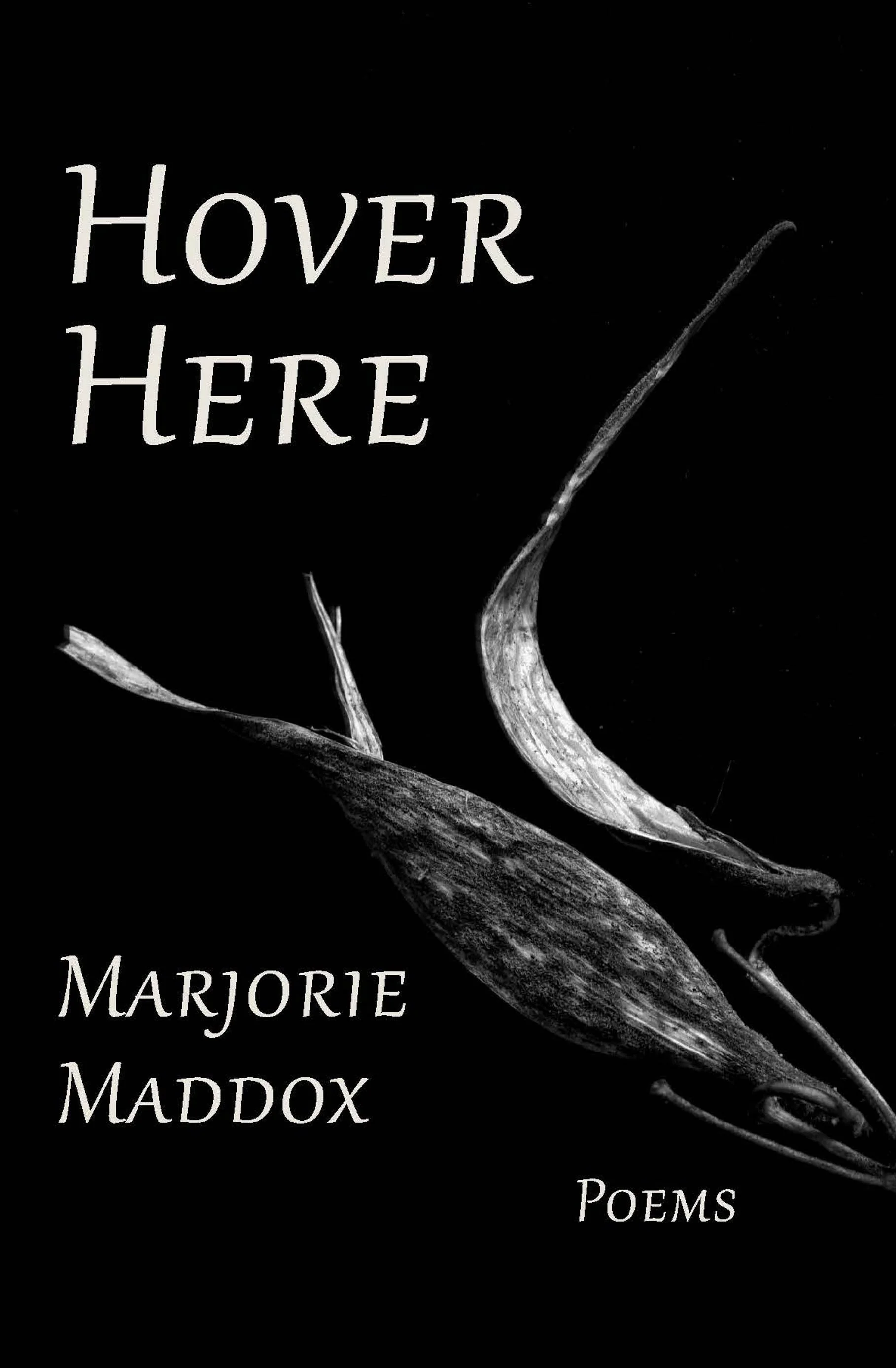
The title poem of Marjorie Maddox’s Hover Here entreats readers to pause to appreciate their “own / sweet precipitation of hope: / no weather of worry, / no stormy deadline of hurry.” There is sweetness in her poems of nature and of the ordinary, “For the pebble, the worm, the clothesline,” all described with exquisite precision and insight, “all the way to the I of the eye that keeps yearning / for attachment.” But hurry is here also, deadlines for dealing with contemporary perils, variously societal and environmental: “Don’t hide behind poems. Wildfires are raging.” She writes in many forms, and her mastery of all expresses and celebrates the potential for order, in poetry at least, and perhaps in life. Her closing ekphrastic poem after the cover artwork of Karen Elias contemplates a milkweed pod, “this empty / and brittle surprise / of beauty” – just so this collection opens and empties to surprise with beauty, and hope.
Praise for Marjorie Maddox & Hover Here
Marjorie Maddox’s Hover Here makes lingering look appealing—in the title poem, in her description of a girl hovering on the stories and dreams of her ancestors, in the wisps of dandelions that hover above a lake in anticipation of spring. Her descriptions of the natural world are vivid—30,000 spines on the porcupine! And there is much to like also in the poet’s other considerations (the account of being a motel maid in the 1970s is one of my favorites), where Maddox turns her attention to coming of age, socio-political justice, and the arts, including a poem inspired by a Judy Collins song.
—Susana H. Case, author of If This Isn’t Love
By turns wise, witty, and profound, these captivating poems teach us “to re-see our lives” in the “silent swooping / of story” as divulged by gull and kite, creek and toad, banjo and drum, loon and “brushstroke of buttercup.” Marjorie Maddox is a master of detail and dissonance, of tenderness and gut-punch, and Hover Here has an almost magical perspective-shifting potency. Here are prayers wordless yet tangible: lament spoken in “billowed sheets,” praise whispered through “small petals,” grace found in “water, fish, wind, wave” and the breeze-carried sparrow—together gorgeously tracing “how prayer, silent, weaves through air.”
—Laura Reece Hogan, author of Butterfly Nebula
There is a playfulness in Marjorie Maddox’s poems that takes us back to the wonders of childhood, finding a sense of the spiritual in the everyday, recognizing the connectedness in all things. Maddox is accomplished in many forms: villanelle, sestina, pantoum, as well as free verse. Many poems acknowledge lateness, autumn, and the passing of friends. Others are meditations on the threats to our environment. Lyrics that celebrate the natural world exhibit both fragility and strength, always with surprise, discovery.
—Robert Morgan, author of Dark Energy
A poet of terrific energy and wise hope, Marjorie Maddox, in Hover Here, attends to our complicated world with complicated love. In an array of enchanting forms, these poems weave artfully through spirited meditations, arriving often at moments of grace and affirmation: “…The cause of things—/ flight, companionship, love—our steady now and then.” A realist, awake to all that threatens our lives, Maddox reminds us that we’re equipped for the struggle. “Beyond flooded neighborhoods,” she writes, “…you get to choose /when to tango in the rain, /when to outstare the storm…” Hover Here is a book one needs.
—David Swerdlow, author of Empty the River
About the Author
Poetry Moment host for WPSU-FM, assistant editor of Presence: A Journal of Catholic Poetry, Sage Graduate Fellow of Cornell University (MFA), and Professor Emerita of English at the Lock Haven campus of Commonwealth University, Marjorie Maddox has published seventeen collections of poetry—including Perpendicular As I (Sandstone Book Award); Transplant, Transport, Transubstantiation (Yellowglen Prize); Begin with a Question (Illumination Book Award, International Book Award, Paraclete Press); and Seeing Things (Wildhouse Publishing); as well as the Shanti Arts ekphrastic collaborations Small Earthly Space; Heart Speaks, Is Spoken For (both with photographer Karen Elias); and In the Museum of My Daughter’s Mind (with her artist daughter Anna Lee Hafer, www.hafer.work, and others), a 2023 Royal Dragonfly Book Award in photography/fine arts and American Fiction Winner Award in poetry.
Maddox also has published the story collection What She Was Saying (Fomite) and five children’s and YA books, including the 2021 National Council of Teachers of English (NCTE) Notable Children’s Poetry Book I’m Feeling Blue, Too! (Wipf and Stock) and the middle-grade biography A Man Named Branch: The True Story of Baseball’s Great Experiment (Loch Ness Books, an imprint of Sunbury Press). She is the great grandniece of Branch Rickey, the general manager of the Brooklyn Dodgers who helped break the color barrier by signing Jackie Robinson to Major League Baseball.
With Jerry Wemple, she co-edited the anthologies Common Wealth: Contemporary Poets on Pennsylvania and Keystone Poetry: Contemporary Poets on Pennsylvania (Pennsylvania State University Press, 2005 and 2025). The recipient of numerous awards, she gives readings and workshops around the country. She lives with her husband in North Central Pennsylvania, where they raised their two (now grown) children.
For more information and to schedule readings, see www.marjoriemaddox.com
Publication Date: January 31, 2026
Paperback, 112 pages
ISBN: 978-1-966677-32-1
The title poem of Marjorie Maddox’s Hover Here entreats readers to pause to appreciate their “own / sweet precipitation of hope: / no weather of worry, / no stormy deadline of hurry.” There is sweetness in her poems of nature and of the ordinary, “For the pebble, the worm, the clothesline,” all described with exquisite precision and insight, “all the way to the I of the eye that keeps yearning / for attachment.” But hurry is here also, deadlines for dealing with contemporary perils, variously societal and environmental: “Don’t hide behind poems. Wildfires are raging.” She writes in many forms, and her mastery of all expresses and celebrates the potential for order, in poetry at least, and perhaps in life. Her closing ekphrastic poem after the cover artwork of Karen Elias contemplates a milkweed pod, “this empty / and brittle surprise / of beauty” – just so this collection opens and empties to surprise with beauty, and hope.
Praise for Marjorie Maddox & Hover Here
Marjorie Maddox’s Hover Here makes lingering look appealing—in the title poem, in her description of a girl hovering on the stories and dreams of her ancestors, in the wisps of dandelions that hover above a lake in anticipation of spring. Her descriptions of the natural world are vivid—30,000 spines on the porcupine! And there is much to like also in the poet’s other considerations (the account of being a motel maid in the 1970s is one of my favorites), where Maddox turns her attention to coming of age, socio-political justice, and the arts, including a poem inspired by a Judy Collins song.
—Susana H. Case, author of If This Isn’t Love
By turns wise, witty, and profound, these captivating poems teach us “to re-see our lives” in the “silent swooping / of story” as divulged by gull and kite, creek and toad, banjo and drum, loon and “brushstroke of buttercup.” Marjorie Maddox is a master of detail and dissonance, of tenderness and gut-punch, and Hover Here has an almost magical perspective-shifting potency. Here are prayers wordless yet tangible: lament spoken in “billowed sheets,” praise whispered through “small petals,” grace found in “water, fish, wind, wave” and the breeze-carried sparrow—together gorgeously tracing “how prayer, silent, weaves through air.”
—Laura Reece Hogan, author of Butterfly Nebula
There is a playfulness in Marjorie Maddox’s poems that takes us back to the wonders of childhood, finding a sense of the spiritual in the everyday, recognizing the connectedness in all things. Maddox is accomplished in many forms: villanelle, sestina, pantoum, as well as free verse. Many poems acknowledge lateness, autumn, and the passing of friends. Others are meditations on the threats to our environment. Lyrics that celebrate the natural world exhibit both fragility and strength, always with surprise, discovery.
—Robert Morgan, author of Dark Energy
A poet of terrific energy and wise hope, Marjorie Maddox, in Hover Here, attends to our complicated world with complicated love. In an array of enchanting forms, these poems weave artfully through spirited meditations, arriving often at moments of grace and affirmation: “…The cause of things—/ flight, companionship, love—our steady now and then.” A realist, awake to all that threatens our lives, Maddox reminds us that we’re equipped for the struggle. “Beyond flooded neighborhoods,” she writes, “…you get to choose /when to tango in the rain, /when to outstare the storm…” Hover Here is a book one needs.
—David Swerdlow, author of Empty the River
About the Author
Poetry Moment host for WPSU-FM, assistant editor of Presence: A Journal of Catholic Poetry, Sage Graduate Fellow of Cornell University (MFA), and Professor Emerita of English at the Lock Haven campus of Commonwealth University, Marjorie Maddox has published seventeen collections of poetry—including Perpendicular As I (Sandstone Book Award); Transplant, Transport, Transubstantiation (Yellowglen Prize); Begin with a Question (Illumination Book Award, International Book Award, Paraclete Press); and Seeing Things (Wildhouse Publishing); as well as the Shanti Arts ekphrastic collaborations Small Earthly Space; Heart Speaks, Is Spoken For (both with photographer Karen Elias); and In the Museum of My Daughter’s Mind (with her artist daughter Anna Lee Hafer, www.hafer.work, and others), a 2023 Royal Dragonfly Book Award in photography/fine arts and American Fiction Winner Award in poetry.
Maddox also has published the story collection What She Was Saying (Fomite) and five children’s and YA books, including the 2021 National Council of Teachers of English (NCTE) Notable Children’s Poetry Book I’m Feeling Blue, Too! (Wipf and Stock) and the middle-grade biography A Man Named Branch: The True Story of Baseball’s Great Experiment (Loch Ness Books, an imprint of Sunbury Press). She is the great grandniece of Branch Rickey, the general manager of the Brooklyn Dodgers who helped break the color barrier by signing Jackie Robinson to Major League Baseball.
With Jerry Wemple, she co-edited the anthologies Common Wealth: Contemporary Poets on Pennsylvania and Keystone Poetry: Contemporary Poets on Pennsylvania (Pennsylvania State University Press, 2005 and 2025). The recipient of numerous awards, she gives readings and workshops around the country. She lives with her husband in North Central Pennsylvania, where they raised their two (now grown) children.
For more information and to schedule readings, see www.marjoriemaddox.com