
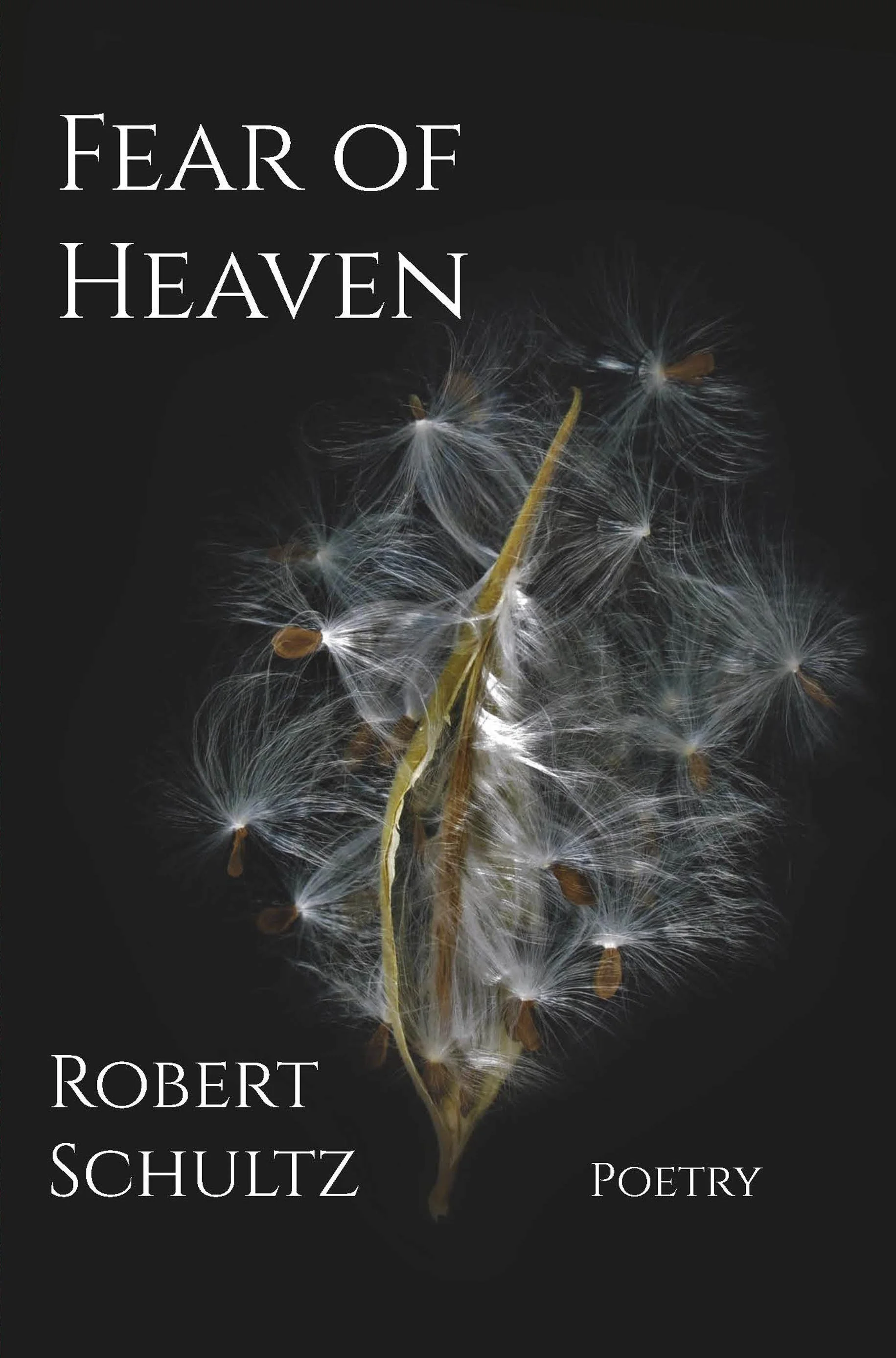
 Image 1 of 2
 Image 2 of 2
Publication Date: June 15, 2026
Paperback, 80 pages
ISBN: 978-1-966677-48-2
Robert Schultz’s poems speak of love lifelong (“There comes a final parting, our time run out / In this lovely world where time presses”) and eternal (“We’ve taken a photograph of the birth of stars / before Earth.”) In Fear of Heaven he questions how long is eternity? “Eternity is not a long time, / but is time’s opposite-flash / that violates the speed of light.” Time is both daily and cosmic, an unfathomable void but also our most precious gift. “Every morning now when I step / out into the green world, it is as if / my last day, not because it is likely / to be, but because it is one day / certain.” Fear of heaven is the fear all share of losing our earthly paradise.
Praise for Robert Schultz & Fear of Heaven
In Fear of Heaven, Robert Schultz takes his readers into the big themes with a lightness of touch. Schultz’s subjects are found in the near and dear, as well as in the far and nearly unfathomable— in family, a long marriage, and his own garden’s wisdom, as well as in the James Webb telescope’s piercing visions. In this book there are potent nods to nature, and life’s inescapable ephemerality emerges in luminous moments in poems such as “Dusting” and “Winter Smoke.” Though evocative of biblical concepts and language, Schultz’s voice is humanistic when in a haiku he declares, “I pass quickly now / into words, like this white rose / imperishable.” To take the poet at his own words on words, in the included essay, the purpose of poetry is “to carry us out of ourselves and into another’s world.” We meet each other everywhere in this poet’s tender, elegiac voice.
—Cathryn Hankla, author of Return to a Certain Region of Consciousness: New & Selected Poems
These poems balance continuing jolts of mortality with visions of the timeless. Fear of Heaven incorporates touches of humor and subtle irony in songs of wonder, in a range of forms: sonnet, couplets, haiku, rhymed and unrhymed lyrics. Schultz conveys with vivid alertness the mysteries of the cosmos and the mysteries of dailiness, connected by a thread of autobiography. The concluding essay on the “primordial” in poetry probes deep into our awe of the gift of language, memory, witness, and bonds of human love.
—Robert Morgan, author of To Honor the Imagined Whole
About the Author
Robert Schultz is the author of nine books in three genres, including a novel, The Madhouse Nudes, and a work of nonfiction, We Were Pirates: a Torpedoman’s Pacific War. He has taught at Cornell University, The University of Virginia, Luther College, and as the John P. Fishwick Professor of Literature at Roanoke College.
Publication Date: June 15, 2026
Paperback, 80 pages
ISBN: 978-1-966677-48-2
Robert Schultz’s poems speak of love lifelong (“There comes a final parting, our time run out / In this lovely world where time presses”) and eternal (“We’ve taken a photograph of the birth of stars / before Earth.”) In Fear of Heaven he questions how long is eternity? “Eternity is not a long time, / but is time’s opposite-flash / that violates the speed of light.” Time is both daily and cosmic, an unfathomable void but also our most precious gift. “Every morning now when I step / out into the green world, it is as if / my last day, not because it is likely / to be, but because it is one day / certain.” Fear of heaven is the fear all share of losing our earthly paradise.
Praise for Robert Schultz & Fear of Heaven
In Fear of Heaven, Robert Schultz takes his readers into the big themes with a lightness of touch. Schultz’s subjects are found in the near and dear, as well as in the far and nearly unfathomable— in family, a long marriage, and his own garden’s wisdom, as well as in the James Webb telescope’s piercing visions. In this book there are potent nods to nature, and life’s inescapable ephemerality emerges in luminous moments in poems such as “Dusting” and “Winter Smoke.” Though evocative of biblical concepts and language, Schultz’s voice is humanistic when in a haiku he declares, “I pass quickly now / into words, like this white rose / imperishable.” To take the poet at his own words on words, in the included essay, the purpose of poetry is “to carry us out of ourselves and into another’s world.” We meet each other everywhere in this poet’s tender, elegiac voice.
—Cathryn Hankla, author of Return to a Certain Region of Consciousness: New & Selected Poems
These poems balance continuing jolts of mortality with visions of the timeless. Fear of Heaven incorporates touches of humor and subtle irony in songs of wonder, in a range of forms: sonnet, couplets, haiku, rhymed and unrhymed lyrics. Schultz conveys with vivid alertness the mysteries of the cosmos and the mysteries of dailiness, connected by a thread of autobiography. The concluding essay on the “primordial” in poetry probes deep into our awe of the gift of language, memory, witness, and bonds of human love.
—Robert Morgan, author of To Honor the Imagined Whole
About the Author
Robert Schultz is the author of nine books in three genres, including a novel, The Madhouse Nudes, and a work of nonfiction, We Were Pirates: a Torpedoman’s Pacific War. He has taught at Cornell University, The University of Virginia, Luther College, and as the John P. Fishwick Professor of Literature at Roanoke College.