
 Image 1 of 1
CARTOGRAPHIC PROJECTIONS OF A SPHERE, a poetry cycle by Estill Pollock
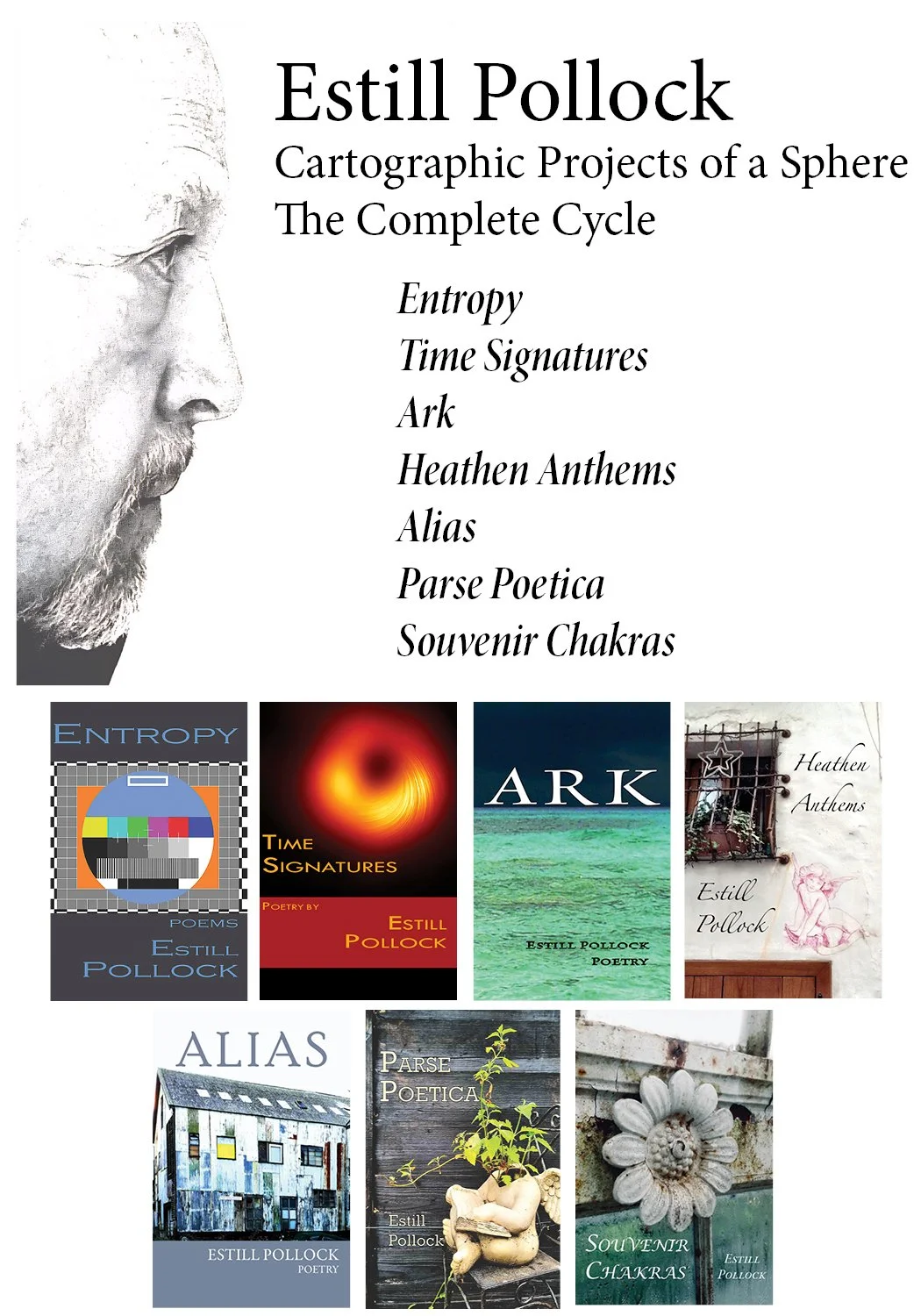
Broadstone Books celebrates the stunning achievement that is the completion of Estill Pollock’s seven volume poetry cycle CARTOGRAPHIC PROJECTIONS OF A SPHERE. Ranging over virtually the entirety of Western canon, culture, history, and science, exhibiting mastery of a wide range of poetry styles and voices, the volumes that make up this series reveal a profound mind and a contemplative spirit at work, and play, in the realm of language. No poetry library that seeks to include the greatest works of the last decade is complete without this series.
We are offering the entire cycle at one-third off the individual retail price (and claiming the POETS24 discount code at checkout will save an additional 20 percent.)
Read below for Estill’s responses to our questions about his process and intentions for this series:
When did you realize that these individual poems written over a very long time in a variety of styles and addressing an incredibly wide range of subjects, then aggregating into individual volumes, were part of a sweeping cycle?
Although there are many poems and these could be said to be written in different voices, thematically there are common threads throughout the works — historical references that balance personal experience and the chronological sweep of factual instance and subject intimacy, the shifting nature of time as it may be apprehended within human interactions and subjective memory and the sooty corners of daily life we return to, long after the grand parade has passed — nothing in the work is invented; it is simply a trick of recollecting the present tense as through metaphysical veils. A better explanation might be to think of ‘today’ as once being someone’s distant future and in the same breath too to recognise it as someone’s distant past. Time is everywhere and nowhere; this table is of oak, but it is also a seething knot of subatomic particles.
And once you did, how did that affect your poetry writing and manuscript assembly process, if at all?
The writing itself is a byproduct of the philosophy noted above. There is no hand-wringing or longingly inspirational asides. The poem begins with a phrase, which becomes a line, then a stanza, then another, then the poem. I think all the books in the Cartographic Projections of a Sphere series were each written in a couple of months. I follow the thread.
How did you decide when you were done with this cycle? Were you writing/compiling toward a predetermined end state?
In the Carto series there was an arc, a kind of charged atmosphere that made itself known, and I think I simply let myself be drawn along its way. Even when I wasn’t physically setting down the poems I was aware of this atmospheric charge, invisible but pervasive, at least as concerned the writing of poems.
While you've lived most of your life in the UK, you occasionally revisit your US (Kentucky) roots in your work. Do you regard yourself as a transatlantic author in terms of your life experience and perspective, part Brit, part Yank? How do these poems serve your larger objectives?
I have lived in England for several decades, certainly far longer than I lived in Kentucky or in the U.S. generally. There was a time when I considered my life in England one of exile, both in fact and conscience. I have returned to the U.S. twice only in all that time, and I think now it’s unlikely that I will ever return. British writer L.P. Hartley’s line, that the past is another country, is well known. What is not often noted is the concluding phrase, ‘…they do things differently there.’ Although my roots are in Kentucky, and I circle back to memories of people and places there from time to time, I know that these no longer exist, the way that people cease to exist, or buildings or country lanes or a house from one’s childhood.